
Storm Damage Restoration
in Dallas–Fort Worth
Rush Dry Restoration responds to storm related water damage and flooding across the Dallas Fort Worth metroplex 24 hours a day. We extract standing water, locate hidden moisture, dry the structure, remove damaged materials, and document everything for your insurance claim. Our work begins the moment the storm allows safe access because the window for effective mitigation is measured in hours, not days.
24/7 Storm Damage Restoration in Dallas–Fort Worth
North Texas storm season runs from spring through early fall, with significant severe weather events possible throughout the year. Hailstorms, straight line winds, tornadoes, and flash flooding are all part of the DFW weather pattern and the interior damage they create can be extensive even when the exterior of a property appears intact.
Rush Dry maintains 24/7 availability specifically because storm damage rarely happens at a convenient time. A storm that rolls through at 2am on a Thursday leaves water intrusion that is already spreading by the time most property owners discover it in the morning. We respond to calls any hour, dispatch immediately, and prioritize arriving while the damage is still in its early stages.
What to Do After Storm Damage
Once the storm has passed and it is safe to assess the property, here is what to do:
- Prioritize safety before entering any area — check for downed power lines near the property, structural damage that may make the building unsafe to enter, and standing water near electrical sources inside
- Document visible damage with photos before moving or removing anything — this initial documentation is valuable for your insurance claim and should happen before any cleanup begins
- Move valuables, electronics, and important documents away from standing water or active dripping if it is safe to do so
- Do not attempt to dry the space with household fans or shop vacs — this moves moisture but cannot extract it from structural materials or prevent mold conditions from developing
- Contact your insurance carrier to report the damage and initiate a claim
- Call Rush Dry immediately so mitigation can begin — every hour of delay allows water to migrate further into walls, flooring, and ceiling assemblies
If the property has sustained significant structural damage, do not enter until it has been cleared as safe. Rush Dry handles the interior water damage restoration, we work alongside roofers, contractors, and other trades as needed to coordinate the full recovery process.
How Storms Cause Interior Water Damage
Storm-related water damage enters DFW properties through several pathways — and the damage is rarely limited to the obvious entry point.
Roof Damage and Water Intrusion
Hail impacts, wind-lifted shingles, and debris damage create openings through which rain enters the attic and saturates insulation and ceiling drywall below. Roof-related water intrusion often goes undetected during the storm itself — the damage becomes apparent hours or days later when ceiling staining, dripping, or visible sagging develops. By that point, the ceiling assembly has already absorbed significant moisture.
Flash Flooding and Groundwater Intrusion
DFW’s flat terrain and clay-heavy soil create conditions where heavy rain accumulates rapidly in low-lying areas. Flash flooding can push water against foundation walls, through door thresholds, window wells, and any gap in the building envelope at grade level. Properties in flood-prone areas can go from dry to significantly flooded in a matter of minutes during an intense rain event.
Wind-Driven Rain Through Wall and Window Assemblies
Severe thunderstorms in DFW regularly produce sustained winds capable of driving rain horizontally against exterior walls and window frames. When seals around windows, doors, or wall penetrations fail under this pressure, water enters wall cavities directly — often without any visible entry point on the interior surface. This type of water intrusion is particularly difficult to detect because the damage is entirely hidden inside the wall assembly.
Storm Drain and Sewer Backup
When storm volume overwhelms municipal drainage systems, water can back up through floor drains, foundation drain systems, and lower-level fixtures. Depending on what enters with the stormwater, this may qualify as category 2 or category 3 water damage — requiring a different level of cleanup protocol than clean water intrusion.
Risks of Storm Water Intrusion
Storm water damage presents risks that go beyond visible property damage. Understanding what is at stake helps explain why emergency response matters:
- Structural weakening — water that saturates wood framing, subfloor panels, and ceiling assemblies reduces their structural capacity over time. Prolonged exposure leads to rot, fastener failure, and in ceiling assemblies, collapse risk
- Mold development — DFW’s warm climate and high summer humidity create favorable conditions for mold growth. Wet materials from storm flooding can support mold colonization within 24 to 48 hours in these conditions
- Electrical hazards — storm flooding that reaches electrical panels, outlets, or appliances creates shock and fire risks. Properties with storm flooding near electrical systems should be treated as unsafe until assessed
- Contents damage — furniture, flooring, stored items, and equipment in contact with storm water deteriorate rapidly. Many contents can be salvaged with professional drying if addressed quickly but become unsalvageable after extended exposure
- Hidden damage — wind-driven rain in wall cavities and roof leak moisture in ceiling assemblies are frequently not apparent on interior surfaces for hours or days after the storm, creating a window where damage is spreading without the property owner’s knowledge
Properties that appear to have sustained only minor visible damage after a storm should still be assessed for hidden moisture — particularly in ceiling assemblies and exterior wall cavities that received wind-driven rain.
Signs You Need Professional Storm Damage Cleanup
- Standing water anywhere inside the property — regardless of depth
- Water staining, discoloration, or active dripping from ceilings
- Sagging or bowing ceiling sections — these indicate saturated drywall under load and are a safety concern
- Wet walls, baseboards, or flooring with no obvious interior source
- Water around the perimeter of the foundation or entering through basement or ground-level openings
- Musty or earthy odor developing in areas that were dry before the storm
- Bubbling or peeling paint on walls or ceilings — often indicates moisture trapped behind the surface
If the storm occurred overnight and you are assessing in the morning, assume hidden moisture migration has already been underway for hours. A professional assessment is the only way to determine the actual scope of damage accurately.
Storm Damage Cleanup and Restoration Process
1. Safety Assessment and Access
2. Damage Documentation
3. Emergency Water Extraction
4. Moisture Mapping
5. Damaged Material Removal
6. Structural Drying
7. Daily Monitoring
8. Completion Documentation
Water Extraction and Structural Drying After Storm Flooding
Storm flooding creates drying challenges that are different from contained interior water damage events. Water that enters from outside the building envelope typically brings debris, contaminants, and moisture into areas that are difficult to access, under crawl spaces, behind exterior wall insulation, and into foundation gaps that are not part of normal interior drying zones.
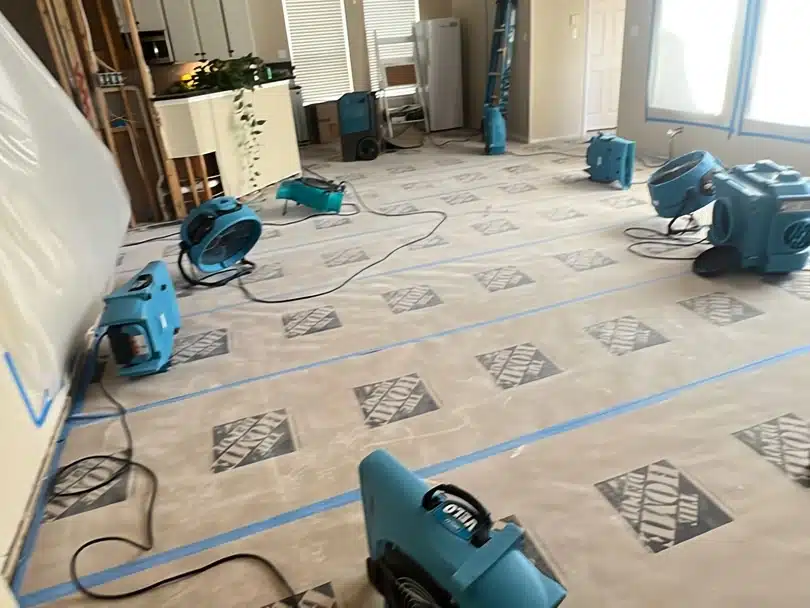
Professional structural drying equipment, commercial dehumidifiers and high velocity air movers, operates at a capacity that consumer equipment cannot replicate. A single commercial dehumidifier removes many times more moisture from the air per hour than multiple consumer units combined. In storm damage situations where moisture has entered building assemblies across a large area, this capacity difference is the determining factor in how long drying takes and whether mold develops before the structure reaches dry standard.
DFW’s summer humidity, often above 70 percent during storm season, creates an additional challenge for drying. High ambient humidity slows evaporation from building materials significantly. Professional dehumidifiers manage interior humidity levels to create effective drying conditions regardless of outdoor conditions.
Residential and Commercial Storm Damage Services
Residential storm damage across DFW most commonly involves roof leak water intrusion into ceilings and attics, ground level flooding from heavy rain, and wind driven rain into wall assemblies. Homes in North Texas communities built on slab foundations are particularly susceptible to ground level water intrusion because there is no below grade drainage buffer between grade and interior floor level.
Commercial properties face storm damage with additional complexity, larger roof areas, more extensive interior square footage, mechanical systems that may have been exposed to water, and occupancy and operational pressures that make extended closure costly. Rush Dry handles commercial storm damage restoration with the same structured process and documentation standards, working with property managers and business owners to minimize downtime while completing mitigation thoroughly.
Serving Dallas–Fort Worth and Surrounding Communities
Plano
Frisco
McKinney
Allen
Richardson
Irving
Garland
Arlington
Fort Worth
Carrollton
Mesquite
Grand Prairie
Denton
Lewisville
Flower Mound
Prosper
Celina
The Colony
If you are in the DFW area and unsure whether you are within our service range, call us directly. We confirm coverage and dispatch immediately.
Insurance Claims Support for Storm Damage
Storm damage is among the most commonly covered events under standard homeowners and commercial property policies. Wind, hail, and storm-related water intrusion are typically covered perils. Flood damage from rising groundwater or municipal overflow may require a separate flood policy.
Rush Dry provides documentation that supports the full claims process:
- Pre-mitigation photo documentation of all storm-damaged areas before any work begins
- Moisture readings at arrival establishing the damage scope at the time of response
- Daily monitoring logs throughout the drying process
- Written scope of loss with itemized material removal and equipment placement
- Post-mitigation documentation confirming the structure reached dry standard
Storm damage claims often involve multiple trades such as roofing, restoration, and reconstruction, each documenting their own scope. Rush Dry’s documentation covers the interior mitigation and drying scope specifically, providing a clear record of what restoration work was required and completed.

Why Fast Response Matters After Storm Damage
Storm damage that is mitigated quickly produces significantly better outcomes than damage left unaddressed for 24 hours or more. Here is what changes with delayed response:
• Water continues to migrate through ceiling assemblies, wall cavities, and under flooring — expanding the affected area with every passing hour
• Saturated ceiling drywall continues to absorb weight, increasing collapse risk over time
• Mold conditions develop in DFW’s warm climate within 24 to 48 hours, turning a water damage restoration job into a combined water and mold remediation project
• Contents — furniture, flooring, stored items, transition from salvageable to unsalvageable the longer they remain in contact with water
• Structural materials that might have been dried in place require removal after extended saturation, increasing the scope of reconstruction
A storm damage response that begins within hours of the event typically results in a contained mitigation project with a defined drying timeline. The same damage left until the following day often requires more aggressive material removal, longer drying times, and in some cases mold remediation that would not have been necessary with earlier intervention.
Storm Damage Emergency Response Across DFW
If your Dallas–Fort Worth property has sustained storm damage, do not wait for morning or for the next business day. Rush Dry responds 24 hours a day with the equipment, process, and documentation to address storm water damage before it spreads further into your structure.
Call (214) 556-8540 — Available 24/7
We serve the entire Dallas–Fort Worth metroplex with emergency storm damage response, water extraction, structural drying, and full documentation for insurance. Call now and get a team moving.