
Ceiling Water Damage Repair
in Dallas–Fort Worth
Rush Dry Restoration responds to ceiling water damage across Dallas Fort Worth 24 hours a day. We assess the full extent of damage, not just the surface, dry the ceiling and surrounding structure, remove materials that cannot be salvaged, and document everything for insurance. Our role begins the moment the visible damage appears and continues until the structure is dry and ready for reconstruction.
Ceiling Water Damage Repair Across Dallas–Fort Worth
Ceiling water damage is one of the more common water damage scenarios Rush Dry responds to throughout DFW, in single-family homes, multi-story townhomes, apartment buildings, and commercial spaces. The source varies: a roof leak during a North Texas storm, a burst pipe on an upper floor, an overflowing appliance, or a slow leak from a second-story bathroom that went undetected for weeks.
Regardless of the source, our response is the same: assess the full scope of damage above and around the visible area, dry the structure completely, remove what cannot be saved, and ensure the ceiling assembly is fully dry before any reconstruction begins.
What to Do When Water Is Leaking Through Your Ceiling
Ceiling leaks create urgency because of the structural risk involved. Here is what to do immediately:
- Clear the area below the leak — move furniture, electronics, and valuables out from under the affected ceiling section. A saturated drywall ceiling can release without warning.
- Do not attempt to puncture or open the ceiling yourself to relieve water pressure. This can accelerate structural failure and cause additional damage to materials that might otherwise be salvageable.
- If the water source is accessible and safe to address, such as an upstairs toilet overflow or a running appliance, stop it. If the source involves roofing or structural concerns, leave it to the appropriate professional and call Rush Dry to address the resulting damage immediately.
- Place buckets or towels to catch dripping water only if it does not require you to stand under the damaged ceiling section.
- Call Rush Dry immediately for emergency water removal. Ceiling water damage worsens rapidly, and the collapse risk increases the longer saturated drywall remains in place.
Do not wait to see if the ceiling dries on its own. Drywall ceilings that appear to stop dripping are often still holding significant trapped moisture that will cause ongoing structural weakening and mold growth if not properly dried.
Common Causes of Ceiling Water Damage in DFW Properties
Identifying the source of ceiling water damage is the first step in stopping ongoing damage. Here are the most common causes Rush Dry encounters across Dallas–Fort Worth:
Roof Leaks
DFW’s storm season — spring hail, summer thunderstorms, and periodic freezing events — creates significant roofing stress. A compromised roof allows water to enter the attic space, where it saturates insulation and eventually reaches ceiling drywall below. Roof leak damage to ceilings often goes undetected until a second or third rain event pushes enough water through to become visible. By that point, the ceiling assembly has typically been wet multiple times.
Upstairs Plumbing Failures
A burst pipe, failed supply line, or overflowing fixture on an upper floor sends water through the subfloor and into the ceiling cavity of the room below rapidly. This is among the fastest-developing ceiling damage scenarios — water can travel from an upstairs bathroom floor to a first-floor ceiling within minutes. Rush Dry handles the water damage restoration after the plumbing source has been addressed.
HVAC Condensate Line Failures
In DFW’s climate, air conditioning runs heavily for much of the year. When a condensate drain line becomes clogged or disconnected, the resulting overflow can saturate ceiling drywall directly below the air handler — often in attic spaces or utility closets. These leaks are frequently slow and go undetected until ceiling damage becomes visible.
Appliance Overflows
Washing machines, dishwashers, and water heaters on upper floors or in elevated utility spaces can overflow and send water through flooring assemblies to ceilings below. These events often release significant volumes of water quickly, and the ceiling damage can be extensive by the time the overflow is discovered.
Is a Water-Damaged Ceiling Dangerous?
Yes, a water-damaged ceiling presents real structural and safety risks that most property owners underestimate. Drywall ceilings are heavy. A standard half-inch drywall panel on a ceiling weighs approximately two pounds per square foot. When that drywall becomes saturated with water, its weight can increase dramatically, and its structural integrity degrades rapidly.
Saturated drywall loses its bond with joint compound and fasteners. The paper face that gives drywall much of its tensile strength weakens significantly when wet. A ceiling section that is visibly sagging or bowing is in immediate danger of partial or full collapse, and collapse can happen without warning, sometimes even after the visible dripping has stopped.
Beyond the structural risk, ceiling water damage creates electrical hazards when water reaches light fixtures, recessed lighting, ceiling fans, or wiring runs through the ceiling cavity. Water in contact with live electrical components is a serious safety concern that requires the area to be treated as unsafe until assessed.
Signs Your Ceiling May Be at Risk of Collapse
Evacuate the area below immediately if you observe any of the following:
- Visible sagging or bowing in any section of the ceiling — even a small amount indicates the drywall is holding more water weight than it can safely support
- A large, soft bubble or blister in the ceiling surface — this indicates a pocket of trapped water that has not yet found a release point
- Cracking along seams or around light fixtures — the drywall is beginning to separate under the combined weight and moisture stress
- Active dripping from multiple points across a ceiling section — water has saturated the full panel and is finding multiple escape routes
- Sounds of creaking or popping from the ceiling — these can indicate fastener failure under load
Do not attempt to assess or stabilize a ceiling that shows these signs. Keep the area clear and call Rush Dry immediately. Our team can safely evaluate and relieve the pressure from a water-loaded ceiling without causing an uncontrolled collapse.
Ceiling Water Damage Repair Process
Rush Dry approaches ceiling water damage with a process designed to address both the visible damage and the hidden moisture above and around it. Rush Dry follows IICRC standards for professional water damage restoration when assessing moisture intrusion, removing unsalvageable materials, and drying ceiling assemblies.
1. Safety Assessment
2. Moisture Mapping
3. Controlled Material Removal
4. Structural Drying
5. Daily Monitoring
6. Documentation
Drying and Moisture Detection Inside Ceiling Assemblies
Ceiling assemblies present unique drying challenges compared to floor-level water damage. Moisture trapped in ceiling insulation, particularly blown fiberglass or cellulose, does not release easily into the air and often cannot be dried in place once saturation reaches a certain point. Wet insulation acts as a moisture reservoir that keeps adjacent framing and drywall elevated in moisture content even after surface readings appear to improve.
Framing above a water-damaged ceiling, including joists, blocking, and sheathing, can hold elevated moisture for significantly longer than wall framing at the same moisture content, simply because the ceiling cavity is more enclosed and receives less natural airflow. Professional drying equipment creates the air circulation and dehumidification capacity needed to dry these assemblies in days rather than waiting for natural evaporation over weeks.
Thermal imaging is particularly valuable in ceiling work because temperature differentials between wet and dry areas are often more pronounced in ceiling assemblies, making it easier to identify the boundaries of moisture migration that surface meters alone might miss.
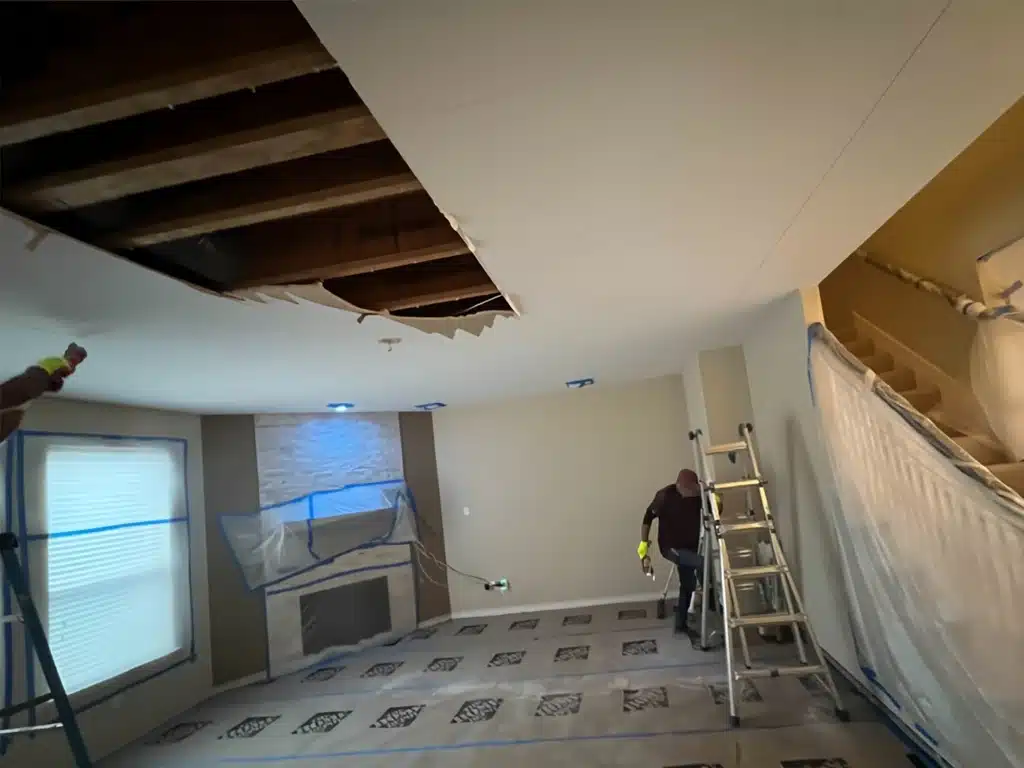
When Ceiling Materials Must Be Removed
Not every water-damaged ceiling requires full drywall removal, but the decision must be based on actual moisture readings, not visual assessment. Here is a general guide:
Ceiling drywall almost always requires removal when:
- It has been saturated for more than 24 hours without professional drying intervention
- It is visibly sagging, bowing, or showing signs of structural failure
- Moisture readings indicate full-panel saturation rather than surface or edge moisture
- There is visible mold growth on the surface or accessible edges of the panel
- The water source involved sewage or contaminated water — category 3 water damage requires removal of all porous materials that were in contact
Ceiling drywall may be salvageable with in-place drying when:
- Moisture is limited to a small area and readings indicate only surface or minor penetration
- The water source was clean and the damage was identified and addressed quickly
- The panel shows no structural compromise and moisture has not reached the paper backing on the upper face
Insulation above a water-damaged ceiling area is evaluated separately. Fiberglass batt insulation that has been saturated generally requires removal, it compresses under moisture load and cannot be reliably dried in place. Blown insulation that has been wet almost always requires removal and replacement.
Residential and Commercial Ceiling Water Damage Repair
Commercial ceiling water damage presents additional complexity, suspended ceiling grid systems, extensive electrical runs, HVAC ductwork, and occupied spaces all affect how restoration work is approached. We work in commercial properties across DFW, coordinating with property managers and tenants to complete the mitigation process efficiently and with minimal disruption to operations.
Serving Dallas–Fort Worth and Surrounding Communities
Plano
Frisco
McKinney
Allen
Richardson
Irving
Garland
Arlington
Fort Worth
Carrollton
Mesquite
Grand Prairie
Denton
Lewisville
Flower Mound
Prosper
Celina
The Colony
If you are in the DFW area and unsure whether you are within our service range, call us directly. We confirm coverage and dispatch immediately.
Insurance Claims Support Ceiling Water Damage
Ceiling water damage from a sudden and accidental source, a burst pipe, appliance overflow, or storm-related intrusion is typically covered under standard homeowners and commercial property policies. Coverage for roof-related damage depends on the policy specifics and the nature of the roofing issue.
Rush Dry provides the documentation the claims process requires from the start:
- Pre-mitigation photo documentation of all visible ceiling damage before any work begins
- Moisture readings establishing the baseline damage scope at arrival
- Daily monitoring logs throughout the drying process
- Written scope of loss with itemized material removal and equipment placement
- Post-mitigation confirmation that the structure reached dry standard before reconstruction
Thorough pre-mitigation documentation is especially important for ceiling damage because the visible surface often does not reflect the full extent of what was affected above. Accurate documentation of what was found, not just what was visible, protects your claim and ensures the reconstruction scope is complete.

Why Fast Response Matters with Ceiling Water Damage
Ceiling water damage has a shorter window for effective intervention than most other water damage scenarios because of the collapse risk and the enclosed nature of the ceiling assembly. Here is what changes with delayed response:
- Structural risk increases — every hour of additional saturation increases the weight load on a compromised ceiling panel and reduces the bond strength holding it in place
- Hidden moisture spreads further into framing, adjacent wall top plates, and insulation — expanding the scope of what must be removed
- Mold conditions develop faster in enclosed ceiling cavities than in open floor-level spaces because airflow is limited and moisture is trapped
- Electrical components in the ceiling — fixtures, recessed lights, wiring runs — sustain increasing damage the longer moisture is present
- Water staining and discoloration that might have been limited to a small area spreads across a larger ceiling surface as water continues to migrate through the drywall panel
A ceiling leak addressed within a few hours of discovery can often be managed with targeted material removal and a contained drying setup. The same leak left overnight frequently requires removal of a much larger ceiling section and longer drying times, because the moisture has had time to spread well beyond the original entry point.
Call Now — Ceiling Water Damage Response Across DFW
If water is leaking through your ceiling or you have discovered ceiling damage from a recent leak, do not wait. Clear the area below, avoid standing under any section that is sagging or bowing, and call Rush Dry immediately. We respond 24 hours a day across Dallas–Fort Worth with the assessment tools, extraction equipment, and drying process to address ceiling water damage before it becomes a structural emergency.
Call (214) 556-8540 — Available 24/7
We serve the entire Dallas–Fort Worth metroplex with emergency response, professional drying, and full documentation for insurance. Call now and get a team moving.

Frequently Asked Questions
What should I do immediately when water is leaking through my ceiling?
Clear the area below the leak and move valuables out from under the affected section. A saturated drywall ceiling can fail without warning. Do not stand under any section that is sagging or bowing. If the source of the water is accessible and safe to address, stop it. Then call Rush Dry immediately. Do not attempt to puncture the ceiling yourself to relieve water pressure.
Is a water-damaged ceiling dangerous?
Yes. Saturated drywall is significantly heavier than dry drywall and loses structural integrity quickly. A ceiling section that is visibly sagging, bowing, or showing cracks along seams is at risk of collapse. Additionally, water in ceiling assemblies frequently contacts electrical wiring, light fixtures, and recessed lighting, creating electrical hazards that make the area unsafe until assessed by a professional.
How long before ceiling water damage becomes a serious problem?
Ceiling damage escalates quickly. Within an hour of an active leak, drywall is absorbing water and the weight load on the ceiling assembly is increasing. Within 24 hours, drywall that might have been dried in place often requires full removal. Mold conditions can develop within 24 to 48 hours in the enclosed ceiling cavity. The sooner the damage is assessed and drying begins, the smaller the overall scope of work.
Can a water-damaged ceiling dry out on its own?
Not reliably, and attempting to let it dry on its own creates more problems than it solves. Drywall that appears to stop dripping is often still holding significant trapped moisture that will continue weakening the panel and supporting mold growth in the ceiling cavity. Professional drying equipment is required to dry the ceiling assembly, including the insulation and framing above, to pre-loss moisture levels.
Does insurance cover ceiling water damage repair?
Coverage depends on the source of the damage and your specific policy. Ceiling damage from a sudden and accidental event, such as a burst pipe, appliance overflow, or storm intrusion, is typically covered under standard homeowners policies. Damage from a slow leak or deferred maintenance may not be covered. Rush Dry documents the full scope of damage from the moment we arrive to support your claim.
How long does ceiling water damage drying take?
Structural drying for a ceiling water damage event typically takes three to five days with daily monitoring once damaged materials have been removed. Ceiling assemblies with significant insulation moisture or framing saturation may require additional time. The timeline depends on the extent of water migration, how long the damage was present before drying began, and the materials involved.
Does the ceiling drywall always need to be replaced?
Not always, but often. The decision is based on actual moisture readings, not visual assessment. Drywall that has been saturated for more than 24 hours, shows structural compromise, or has moisture throughout the full panel almost always requires removal. Drywall with limited surface moisture that was identified and addressed quickly may be salvageable with in-place drying. Rush Dry makes removal recommendations based on industry standards and direct moisture measurement.
Do you serve my area in DFW?
Rush Dry serves the full Dallas–Fort Worth metroplex including Dallas, Plano, Frisco, McKinney, Allen, Richardson, Irving, Garland, Arlington, Fort Worth, and surrounding communities. Call (214) 556-8540 to confirm service for your specific location.