
Property Reconstruction Services in Dallas–Fort Worth
Reconstruction services in Dallas–Fort Worth restore homes and commercial properties after fire damage, water damage, mold remediation, and other major disasters. But in many significant loss situations, restoration alone does not return a property to its pre-loss condition. Walls, flooring, ceilings, framing, and other structural components that were damaged beyond repair or removed during the mitigation process must be rebuilt. Reconstruction services in Dallas–Fort Worth are the final and often most visible phase of recovery, the work that transforms a stabilized, mitigated property back into a fully functional home or business.
Rush Dry Restoration provides professional property reconstruction services following fire damage, water damage, mold remediation, and other disasters for residential and commercial properties throughout Dallas–Fort Worth. Managing both the restoration and reconstruction phases through a single, coordinated team simplifies the recovery process, maintains continuity of documentation for insurance purposes, and eliminates the delays that occur when property owners must independently source and coordinate a separate reconstruction contractor after restoration is complete. Reconstruction services in Dallas–Fort Worth handled by the same team that performed the restoration means fewer gaps, clearer accountability, and a more efficient path to full recovery.
Professional Reconstruction Services After Property Damage
In many restoration projects, content pack-out services are performed before reconstruction begins so belongings can be cleaned and protected during the rebuilding process. Reconstruction follows the mitigation and restoration phases of the recovery process. Mitigation stabilizes the property and stops ongoing damage. Restoration removes damaged materials, dries the structure, and addresses contamination. Reconstruction rebuilds what was removed or destroyed, restoring the property to a livable, functional, and structurally sound condition. The transition from restoration to reconstruction is a critical coordination point. Materials removed during mitigation leave openings in walls, ceilings, and floors. Structural components weakened by fire or water require replacement before finishes can be reinstalled. Systems including electrical, plumbing, and HVAC may need repair or modification as part of the rebuild. Professional reconstruction services manage this transition systematically, ensuring that rebuilt areas meet current standards and that the completed property reflects the scope of work documented throughout the restoration process.When Reconstruction Is Required After a Disaster
Not every restoration project requires significant reconstruction, but several common damage scenarios consistently result in structural rebuilding needs.
- Fire damage structural repairs frequently involve replacing framing, sheathing, and structural components that were burned, heat-damaged, or removed during fire mitigation. Even in fires that appear contained, structural assessment often reveals damage that requires rebuilding beyond what is visible at the surface.
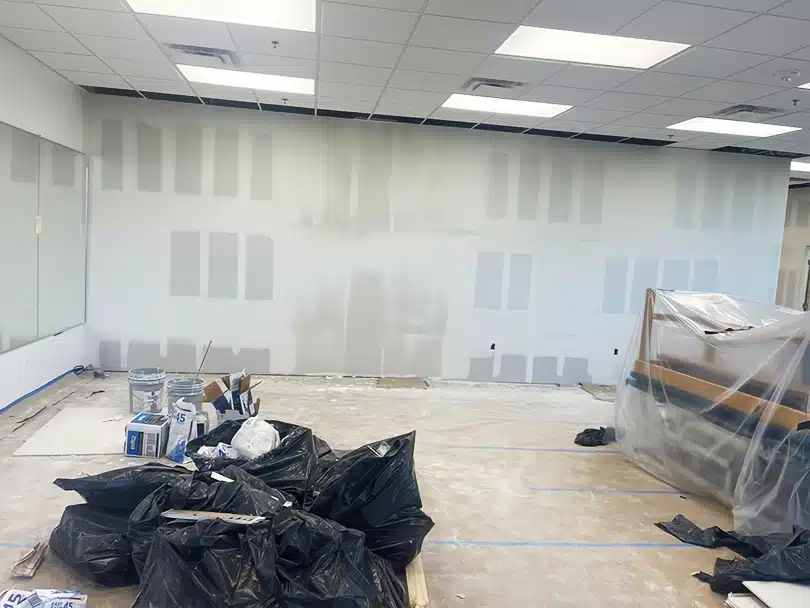
- Water damage reconstruction becomes necessary when drywall, flooring, insulation, and other materials saturated beyond restorability are removed during the drying process. Cavities opened for drying must be closed and refinished as part of the recovery.
- Mold damage repairs following remediation involve replacing materials that were removed to eliminate mold contamination — drywall, framing, insulation, and other affected components that could not be cleaned and retained.
- Storm damage rebuilding addresses structural damage from high winds, hail, falling trees, and severe weather events that compromise roofing, exterior walls, windows, and structural assemblies.
- Structural repairs following major property loss — including losses that affect multiple systems or large portions of the structure, require coordinated reconstruction planning to sequence the work correctly and ensure that all systems are functional and code-compliant upon completion.
Our Reconstruction Process
Rush Dry Restoration follows a structured reconstruction process designed to rebuild damaged properties efficiently, correctly, and in full coordination with the documentation requirements of the insurance claims process.
Step 1: Damage Assessment and Reconstruction Planning
Step 2: Structural Repairs and Framing
Step 3: Drywall, Flooring, and Interior Finishes
Step 4: Electrical, Plumbing, and Mechanical Repairs
Step 5: Final Reconstruction and Property Restoration
Residential Reconstruction Services
For homeowners, the reconstruction phase represents the point at which their property begins to look like home again. Fire-damaged walls, water-stained and removed ceilings, and exposed framing left from mold remediation are the visible reminders of the loss that reconstruction resolves.
Rush Dry Restoration approaches residential reconstruction with attention to matching existing finishes, maintaining consistent quality across rebuilt and unaffected areas, and communicating clearly with homeowners throughout the build process. Whether the scope involves a single room or significant portions of the home, the goal is the same: returning the property to a condition that meets or exceeds pre-loss standards, with documentation that supports the insurance process from start to finish.
Commercial Reconstruction Services
Commercial reconstruction carries operational and financial urgency alongside the physical rebuilding work. Every day a business facility remains out of operation or partially functional represents real cost in revenue, in tenant relationships, and in operational disruption. Rush Dry Restoration provides reconstruction services for offices, retail spaces, apartment buildings, warehouses, and other commercial properties throughout Dallas–Fort Worth. Commercial reconstruction is planned and executed with attention to minimizing downtime, sequencing work to allow partial occupancy where possible, and maintaining the documentation standards that commercial property insurance and property management require. Clear project management, consistent communication with ownership and management, and structured scheduling keep commercial reconstruction projects on track toward full restoration of function and occupancy.Coordinating Reconstruction With Insurance Claims
One of the most significant practical benefits of having the restoration and reconstruction phases managed by the same team is continuity of insurance documentation. From the initial loss documentation through mitigation and into reconstruction, Rush Dry maintains organized records of damage conditions, scope of work, materials used, and progress throughout the project.
Insurance reconstruction claims require detailed documentation of what was damaged, what was removed, what is being replaced, and at what cost. When this documentation is maintained consistently from the beginning of the restoration process, the transition to the reconstruction phase of the claim is significantly smoother. Rush Dry works with property owners to ensure that reconstruction scope aligns with documented damage, that supplemental claims are supported by accurate records, and that the overall recovery process moves forward without unnecessary delays related to documentation gaps.
Serving the Entire Dallas–Fort Worth Area
Rush Dry Restoration provides property reconstruction services throughout the Dallas–Fort Worth metroplex. Our team works on properties across the region, including Dallas, Plano, Frisco, Allen, McKinney, Richardson, Garland, and Carrollton, as well as surrounding communities throughout North Texas.
Our coverage across the metroplex allows us to manage restoration and reconstruction as a continuous, coordinated process for properties throughout the Dallas–Fort Worth area, without the handoff delays that occur when restoration and rebuilding are handled by separate companies.
Why Choose Rush Dry Restoration
- Experienced reconstruction professionals — Our reconstruction team brings hands-on experience across residential and commercial rebuild projects following fire, water, mold, and storm damage throughout Dallas–Fort Worth.
- Full-service restoration and rebuilding — Managing both restoration and reconstruction through a single team eliminates coordination gaps, maintains documentation continuity, and simplifies the recovery process for property owners and insurers.
- Coordination with insurance claims — Rush Dry maintains thorough documentation throughout both the restoration and reconstruction phases, supporting the insurance process with organized records from initial damage assessment through final completion.
- High-quality structural repairs — Reconstruction work is performed to current building standards, with attention to matching existing finishes and restoring the property to a condition that reflects the quality and care invested in the rebuild.
- Fast response across Dallas–Fort Worth — Our team is positioned to begin reconstruction planning as soon as the restoration phase is complete, reducing the gap between mitigation and rebuilding that can extend recovery timelines unnecessarily.
Schedule Reconstruction Services
Property damage does not resolve until the structure is fully rebuilt and restored to functional condition. If your home or business has sustained damage requiring structural repairs, material replacement, or full reconstruction, Rush Dry Restoration provides professional reconstruction services in Dallas–Fort Worth as part of a complete, coordinated recovery process.
Call (214) 556-8540 to discuss your reconstruction needs. Our team is ready to assess the scope of work, coordinate with your insurance process, and begin rebuilding your property with the quality and professionalism your recovery requires.

Frequently Asked Questions
What is reconstruction after property damage?
Reconstruction is the phase of recovery that follows mitigation and restoration. It involves rebuilding structural components, replacing removed or damaged materials, repairing affected systems, and restoring interior finishes, returning the property to a fully functional, structurally sound condition. Reconstruction addresses what restoration cannot: the physical rebuilding of what was removed or destroyed during the damage event and the mitigation process.
How long does reconstruction take after fire or water damage?
Timeline depends on the scope of damage, the extent of structural work required, systems repairs needed, and the complexity of finish restoration. Smaller reconstruction scopes involving one or two rooms may be completed within a few weeks. Larger losses involving significant structural damage, systems repairs, and full interior restoration can take considerably longer. Rush Dry provides a clear timeline estimate following scope development and updates throughout the reconstruction process.
Is reconstruction covered by insurance?
Reconstruction following a covered loss, such as fire or water damage, is typically included in homeowner’s and commercial property insurance coverage. Coverage specifics depend on policy terms, the cause of the loss, and the documented scope of damage. Rush Dry provides thorough documentation throughout both the restoration and reconstruction phases to support the insurance review and approval process.